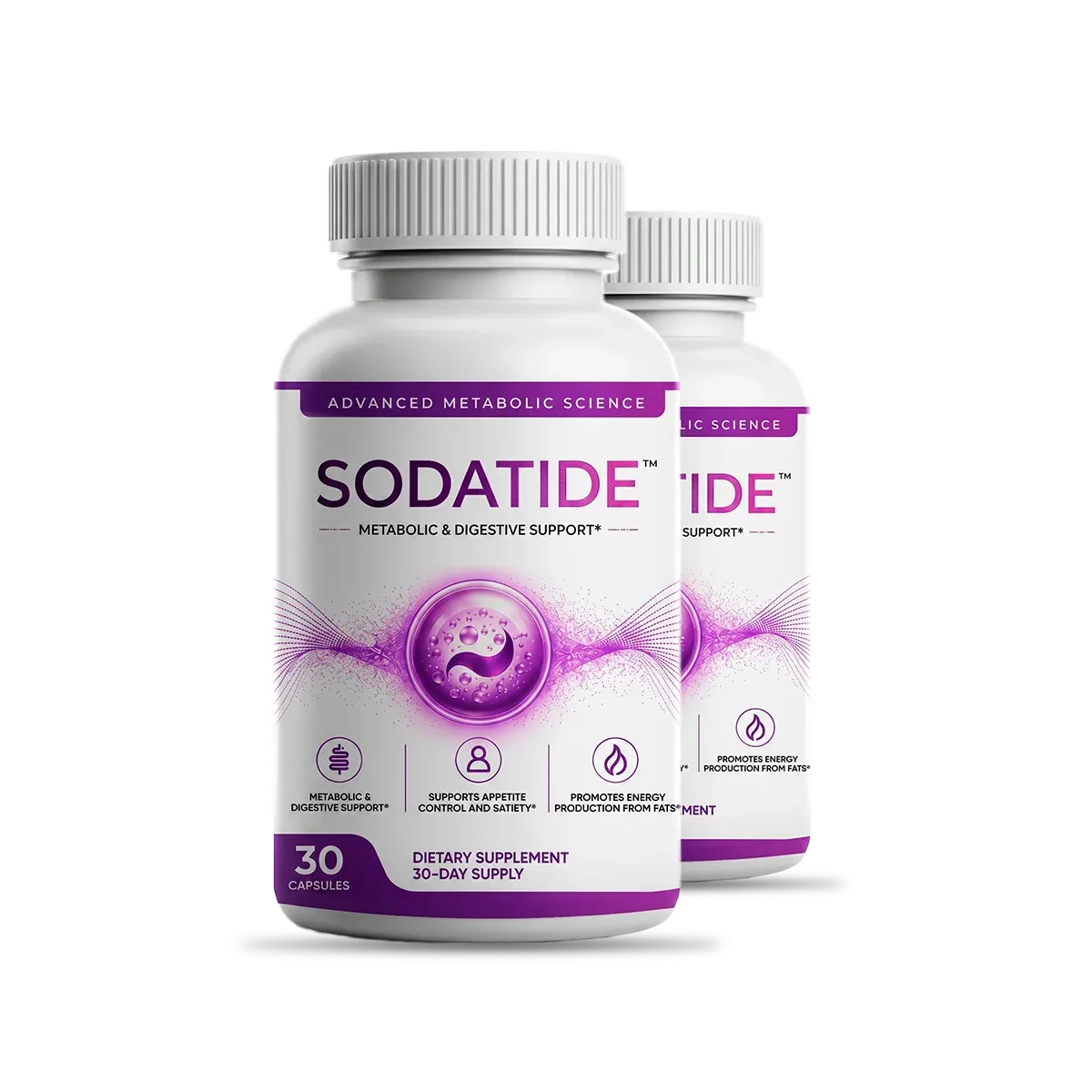
How Sodatide Works: Fiber, Gut Bacteria and Fullness Hormones
Quick answerSodatide works through gut bacteria: its fiber is fermented in the colon into compounds that can signal fullness.
The 311 mg of fiber reaches the colon undigested and becomes short-chain fatty acids such as butyrate, which can trigger GLP-1 and PYY. Three probiotic species are added. Human studies used 12 to 34 g of fiber a day.
What is the basic idea behind Sodatide?
Sodatide works on a simple plan: feed the gut bacteria, and add a few helpful ones. The fiber half gives resident microbes something to eat. The probiotic half adds three named species.
What the bacteria make from that fiber is the key. Their by-products act as messengers between the gut and the rest of the body. That link is the reason a gut product can carry a metabolic claim at all.
The ingredients themselves are covered one by one on the Sodatide ingredients page. The story below starts the moment you swallow the capsule.
The mechanism chain, step by step
The chain has five links. Each one depends on the one before it. Here they are in order, from the capsule to the brain.
Fiber passes the small intestine
Your body has no enzyme to split inulin or resistant starch. Both travel through the stomach and small intestine untouched and arrive in the colon (Vandeputte et al., 2017).
Gut bacteria ferment it
In the colon, trillions of bacteria break the fiber down for energy. The process is called fermentation, and it happens without oxygen.
Short-chain fatty acids are made
Fermentation leaves behind acetate, propionate and butyrate. With 28-34 g a day of resistant potato starch, butyrate rose by about 29% on average (Baxter et al., 2019).
Hormone cells pick up the signal
Special cells in the gut wall sense these acids. They can respond by releasing GLP-1 and PYY, two hormones linked to fullness (Byrne et al., 2015).
The brain gets the message
GLP-1 and PYY travel in the blood and along nerves. They tell the brain that food has arrived, which is part of how the body sets meal size.
What does fermentation actually produce?
Fermentation turns fiber into short-chain fatty acids, or SCFAs. Acetate, propionate and butyrate are the three main ones. Gases such as hydrogen and carbon dioxide are made too, which explains the mild gas some people notice with new fiber.
Butyrate gets the most attention. It is the main fuel for the cells that line the colon. Propionate travels to the liver, and acetate reaches the wider bloodstream.
Not everyone makes the same amount. In the potato starch study above, only about 63% of people saw butyrate rise (Baxter et al., 2019). Your own gut bacteria shape the outcome.
How are GLP-1 and PYY connected to gut bacteria?
GLP-1 and PYY are hormones made by L-cells in the gut wall. These cells sit mostly in the lower small intestine and the colon, right where fiber is fermented. They carry sensors that respond to short-chain fatty acids.
When the sensors are triggered, L-cells release GLP-1 and PYY. Both hormones slow the stomach and signal fullness. A review of this research found the link is real in lab work, but human results are inconsistent (Byrne et al., 2015).
That review also noted that human studies used about 16-30 g of fiber a day. A related fiber trial saw PYY rise and the hunger hormone ghrelin fall with 21 g a day (Parnell & Reimer, 2009).
Not a GLP-1 drug
Sodatide is a dietary supplement, not a GLP-1 medicine. It does not contain any hormone or drug. The GLP-1 link describes how the body responds to fermented fiber in general.
What role does each probiotic species play?
Each species in the blend was picked for a different job. One pairs with the fiber, one makes butyrate, and one lives in the gut lining.
B. infantis
A bifidobacterium. It belongs to the group that inulin feeds most, so it pairs naturally with the fiber half of the formula.
C. butyricum
A spore-forming species that makes butyrate directly. It adds a butyrate producer on top of the ones already in your gut.
A. muciniphila
Lives in the mucus layer of the gut lining. A pasteurized form was linked to better insulin sensitivity in a small trial (Depommier et al., 2019).
Probiotic effects depend on the exact strain and dose (Hill et al., 2014). The Sodatide label names the species but not the strains or cell counts. The deeper story on the third species is in our Akkermansia explainer.
Where does each ingredient fit in the chain?
| Ingredient or step | Where it fits | What studies measured | Dose studied |
|---|---|---|---|
| Chicory root inulin (211 mg) | Steps 1-2: food for bifidobacteria | 12 g a day raised Bifidobacterium and softened stools (Vandeputte et al., 2017) | 12 g a day, 4 weeks |
| Potato resistant starch (100 mg) | Steps 1-3: butyrate production | Butyrate up about 29% on average; about 63% responded (Baxter et al., 2019) | 28-34 g a day |
| Short-chain fatty acids | Step 4: GLP-1 and PYY | Can trigger both hormones; human results inconsistent (Byrne et al., 2015) | About 16-30 g fiber a day |
| A. muciniphila | Gut lining species | Insulin sensitivity improved about 29% in 32 adults (Depommier et al., 2019) | 10 billion pasteurized cells a day, 3 months |
| Three-species formula plus inulin | Whole synbiotic idea | Better after-meal glucose; maker funded and ran it (Perraudeau et al., 2020) | Six capsules a day, different formula |
What does the science show, and what does it not show?
The chain on this page is well described in research. The open question is dose. Most human data used grams of fiber and billions of cells, while Sodatide provides milligrams.
What the research shows
- Inulin feeds bifidobacteria in people (Vandeputte et al., 2017)
- Resistant potato starch raises butyrate in most people (Baxter et al., 2019)
- SCFAs can trigger GLP-1 and PYY (Byrne et al., 2015)
- Pasteurized Akkermansia improved insulin sensitivity in a small trial (Depommier et al., 2019)
What it does not show
- No trial has tested the finished Sodatide capsule
- Fiber studies used 12-34 g a day; Sodatide has 0.31 g
- The label gives no CFU count or strain codes
- Human GLP-1 and PYY results are inconsistent
One trial is often linked to formulas like this one (Perraudeau et al., 2020). It tested the same three species plus inulin and found better after-meal glucose. But that product was taken as six capsules a day, it was a different formula, and its maker funded and ran the study. It tells us the species combination has been studied, not how Sodatide performs.
How do the three label claims map to the mechanism?
Each claim on the Sodatide label lines up with one part of the chain. Seeing the match makes the claims easier to read.
- Metabolic & Digestive Support matches steps 1 to 3: fiber feeding bacteria and softer, more regular digestion.
- Supports Appetite Control And Satiety matches steps 4 and 5: SCFAs, GLP-1, PYY and fullness.
- Promotes Energy Production From Fats matches the role of SCFAs as fuel and messengers in energy handling.
The asterisk means the FDA has not reviewed these claims. A full walk-through of each one is on Sodatide benefits.
How can food and habits support the same process?
The same chain runs on the fiber you eat. Beans, lentils, oats, onions, garlic, cooked-and-cooled potatoes and green bananas all feed it. A bowl of lentils adds grams of fiber, not milligrams.
Water matters too, because fiber pulls water into the gut. Regular meals, sleep and movement shape your gut bacteria as well. Our gut health guide lists simple food swaps, and how to take Sodatide covers the daily routine.
How long does the chain take to respond?
Gut bacteria can shift within weeks. In the inulin study, changes showed up after four weeks at 12 g a day (Vandeputte et al., 2017). The Akkermansia trial ran for three months (Depommier et al., 2019).
No one has timed these steps at Sodatide's doses. A fair plan is to take it daily for several weeks and watch simple signs. The Sodatide results timeline gives a week-by-week guide.
How Sodatide works: FAQ
Does Sodatide raise GLP-1?
No study has measured GLP-1 with Sodatide itself. Research shows short-chain fatty acids from fiber can trigger GLP-1, but human results are mixed and used about 16-30 g of fiber a day.
Is Sodatide a GLP-1 drug?
No. Sodatide is a dietary supplement made of fibers and bacteria. It contains no drug and is not a substitute for any prescription.
What are short-chain fatty acids?
They are small acids that gut bacteria make when they ferment fiber. The main three are acetate, propionate and butyrate.
Why does Sodatide include probiotics as well as fiber?
The fiber feeds bacteria already in your gut. The probiotic blend adds three named species on top. Pairing both is called a synbiotic.
Is there a clinical trial of Sodatide itself?
No trial of the finished Sodatide capsule has been published. The research cited on this page tested the ingredients, often at larger doses.
What was the Perraudeau 2020 study?
It tested a six-capsule-a-day formula with the same three species plus inulin in adults with type 2 diabetes. The maker of that formula funded and ran it, and it is a different product from Sodatide.
How long does the gut take to respond to fiber?
In one study, gut bacteria shifted after 4 weeks of 12 g a day of inulin. Changes at lower doses have not been measured.
Ready to try Sodatide?
One capsule a day, 30 capsules per bottle, from $49 a bottle with a 60-day money-back guarantee. Questions first? Every desk is listed on the contact page.