"Supports Appetite Control and Satiety": What the Research on Sodatide’s Fibers Shows
Quick answerThe Sodatide front label claims “Supports Appetite Control And Satiety.”* The asterisk points to the standard FDA disclaimer. Human trials on chicory inulin and resistant starch tested doses of 16 to 48 grams a day and mostly found no significant change in hunger hormones or food intake; one acute trial found a same-day effect at the next meal. Sodatide’s capsule has 211 mg inulin and 100 mg resistant starch, 0.311 g combined — roughly 1/50th to 1/150th of the tested amounts.
What does "Supports Appetite Control and Satiety" actually say?
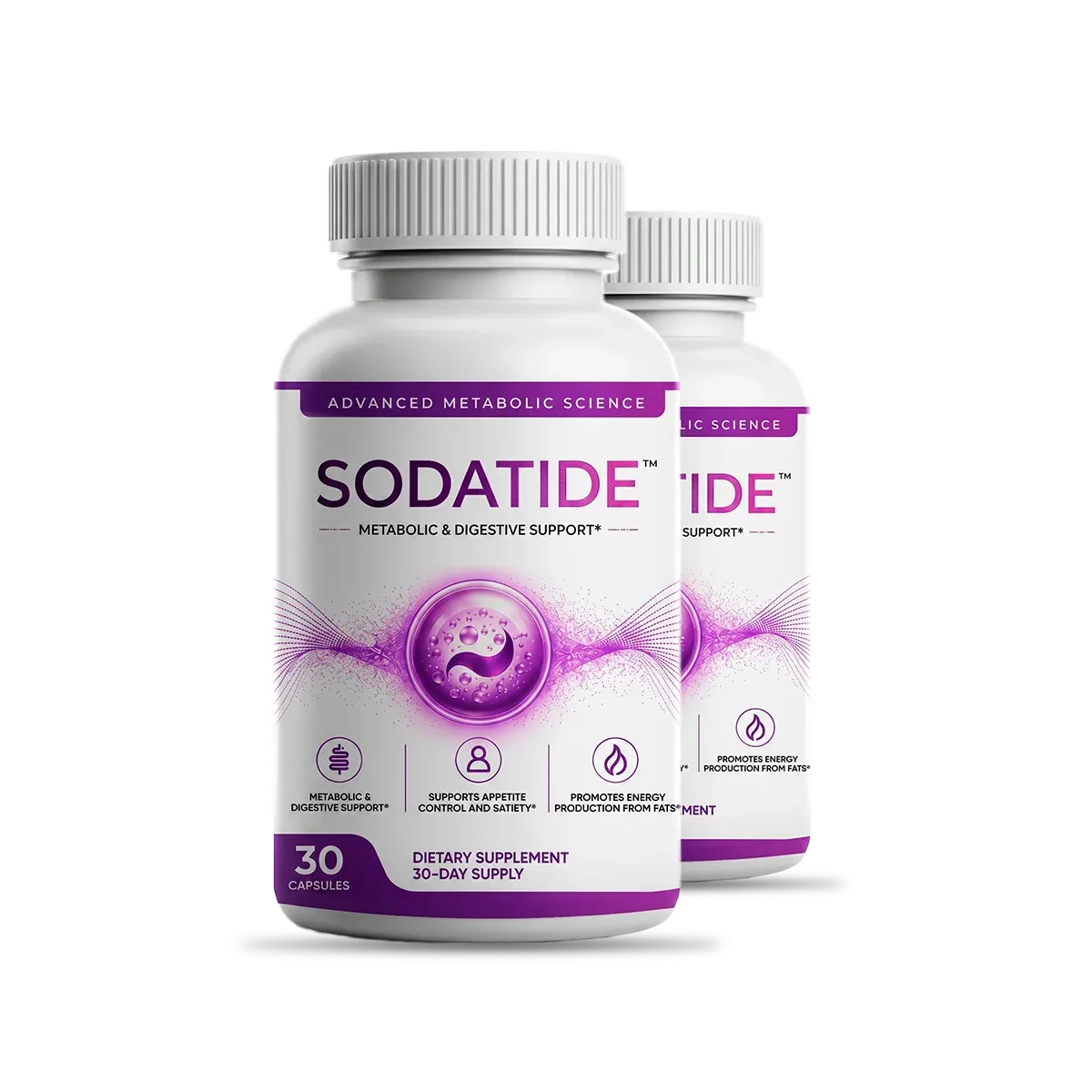
The Sodatide bottle prints three front-label claims, each with an asterisk: "Metabolic & Digestive Support," "Supports Appetite Control And Satiety" and "Promotes Energy Production From Fats." The asterisk on each one leads to the same sentence: these statements have not been evaluated by the FDA, and the product is not intended to diagnose, treat, cure or prevent any disease.
That single sentence covers a specific legal category called a structure/function claim. A supplement maker can say an ingredient supports a normal body function — appetite, digestion, energy — without running the claim past the FDA first, as long as the claim is truthful, not misleading, and carries the disclaimer. The agency does not pre-approve the wording or check the science before the bottle ships.
That does not mean the claim is baseless. It means the burden of checking the science sits with whoever reads the label. So this article does that: it looks at what chicory root inulin and potato resistant starch — the two named fibers on the Sodatide Supplement Facts panel — actually did to appetite-related hormones and food intake in controlled human trials, and at what dose.
The three hormones behind "appetite control"
"Appetite control" on a fiber label almost always traces back to three gut hormones that trials measure in blood samples:
- Ghrelin — released mainly by the stomach when it is empty; often called the "hunger hormone" because levels rise before a meal and fall after one.
- PYY (peptide YY) — released by cells in the lower gut after eating; higher PYY is linked to feeling full.
- GLP-1 — also released after eating; slows stomach emptying and adds to the fullness signal.
The theory is straightforward: fiber that reaches the colon gets fermented by bacteria into short-chain fatty acids, and those short-chain fatty acids can trigger gut cells to release more PYY and GLP-1, and in some study designs, lower ghrelin. Whether that theory shows up as a measurable effect depends heavily on how much fiber reaches the colon intact, and that is a question of dose.
What did controlled trials on inulin-type fructans find?
Two controlled human trials measured inulin-type fructans against appetite hormones directly, at doses far above a Sodatide capsule.
16 g a day in adults with type 2 diabetes
A randomised, placebo-controlled crossover trial gave 35 adults with type 2 diabetes 16 g a day of inulin-type fructans for six weeks, against a maltodextrin control, with a four-week washout between arms (Birkeland et al., 2021). The result ran against the simple story: compared to the control period, the fructans did not change ghrelin (p=0.71), hunger, satiety, fullness or how much food people ate afterward. PYY actually rose more after the control treatment than after the fructans (p=0.013) — the opposite direction from what an appetite-suppressing effect would predict.
An acute bread-based trial at 12% fructan
A smaller, acute, single-blind crossover trial fed 11 adults bread enriched with 12% inulin or 12% fructooligosaccharides and measured breath hydrogen, satiety ratings, active ghrelin, total PYY and same-day energy intake (Morris et al., 2015). Despite the fructan-enriched loaves clearly fermenting (breath hydrogen rose, confirming the fiber reached the colon and was being fermented), there were no significant differences in satiety (p=0.129), ghrelin (p=0.684), PYY (p=0.793) or energy intake (p=0.240) compared with a standard bread. The authors called their own findings "preliminary" and said longer trials were needed.
Both trials used inulin-type fructans at gram-level doses — 16 g a day sustained for six weeks, or a single serving around 12% of a loaf of bread. Neither is close to the 211 mg (0.211 g) of chicory root inulin in one Sodatide capsule.
What did controlled trials on resistant starch find?
Resistant starch has a similar record: mostly null results at sustained gram doses, with one acute exception.
45 g a day for 12 weeks found nothing
A randomized controlled trial gave 59 adults with prediabetes 45 g a day of high-amylose maize resistant starch (RS2) or an isocaloric amylopectin control for 12 weeks, then measured subjective appetite, GLP-1, PYY, ghrelin and food intake at a laboratory buffet test (White et al., 2020). The RS2 group showed no effect on any appetite measure and no effect on total energy, carbohydrate, protein or fat intake at the buffet test, relative to the control group. The trial’s own title states the conclusion plainly: "Resistant Starch Has No Effect on Appetite and Food Intake in Individuals with Prediabetes."
A 48 g acute dose changed the next meal, not the whole day
A single-blind randomized crossover trial gave overweight or obese men 48 g of resistant starch split across breakfast and lunch, then measured glucose, insulin, GLP-1 and appetite every 30 minutes for 7 hours, followed by a free-choice dinner (Al-Mana & Robertson, 2018). Energy intake at that evening’s ad libitum dinner was significantly lower after the resistant starch day (p=0.017). But intake over the full 24 hours was not significantly different, and subjective satiety ratings were not significantly different either. GLP-1 and insulin responses also did not differ significantly between the resistant starch and placebo days.
So even the positive-looking result was narrow: a lower intake at one specific meal, with no measurable change in appetite hormones and no change across the full day. The dose was 48 g, taken as a concentrated starch supplement at two meals — about 480 times the 100 mg of potato resistant starch in a Sodatide capsule.
What a capsule can and can’t be expected to do
Sodatide pairs 211 mg chicory root inulin and 100 mg potato resistant starch with a 36 mg probiotic blend, one capsule a day, from $49 a bottle with a 60-day money-back guarantee.
How far is a Sodatide capsule from the tested doses?
| Fiber | Sodatide per capsule | Study dose tested | Approx. gap |
|---|---|---|---|
| Chicory root inulin | 211 mg | 16 g/day for 6 weeks (Birkeland et al., 2021) | About 76 times lower |
| Potato resistant starch | 100 mg | 45 g/day for 12 weeks (White et al., 2020) | About 450 times lower |
| Resistant starch (acute) | 100 mg | 48 g in one day (Al-Mana & Robertson, 2018) | About 480 times lower |
None of this means 211 mg or 100 mg "does nothing" in some absolute sense — these trials were not designed to test milligram doses, so they cannot rule a small effect in or out. It means the hormone changes these trials looked for were tested at gram-scale amounts, and a capsule supplies a small fraction of that scale. The Inulin vs. Resistant Starch article on this blog covers the same dose gap for the fibers’ other studied effects.
Why did one acute trial look different from the rest?
It is worth sitting with the one result that did move: the Al-Mana & Robertson acute trial found lower intake at an evening meal after a 48 g resistant starch day, even though hormones and whole-day intake did not change significantly. A few things can explain a gap like that:
Mechanical fullness is not a hormone signal
A large, bulky starch dose can slow stomach emptying and create a physical sense of fullness at the next meal, independent of ghrelin, PYY or GLP-1 moving on a blood test. That is plausible at 48 g; it is a different question at 100 mg.
Small samples produce noisy single-meal results
Acute crossover trials with a handful of participants can find a real effect at one measurement point that does not hold up over a full day or in a bigger, longer trial — which is exactly the pattern across these four studies: the smallest, shortest trial found the narrowest positive result, and the two 12-week, dozens-of-participants trials found none.
Null results do not mean failed studies
White et al. 2020 and Birkeland et al. 2021 were well-designed, adequately sized randomized trials that happened to find no effect. A null result from a rigorous trial is informative; it is not the same as a poorly run study that simply missed something.
What does a structure/function claim legally require?
Under U.S. dietary supplement law, a structure/function claim like "Supports Appetite Control and Satiety" does not require the maker to run a clinical trial on the finished product, and the FDA does not review the claim’s wording before the product goes to market. The requirements are narrower: the claim must be truthful and not misleading, the maker must have substantiation on file if asked, and the label must carry the disclaimer that the statement has not been evaluated by the FDA and the product is not meant to diagnose, treat, cure or prevent disease.
That is a real legal distinction from a health claim (which requires FDA review) or a drug claim (which requires proof of safety and effectiveness for a specific condition). It explains why a label can print "Supports Appetite Control" built on the general biology of fiber fermentation, without pointing to a trial of the capsule itself at its printed dose. For more on how the whole panel is built, see Sodatide Supplement Facts: The Label Read Line by Line.
Where does this leave a buyer?
What the research supports
- Chicory inulin and potato resistant starch are both fermented by gut bacteria into short-chain fatty acids, which can in principle signal fullness-related hormones.
- At least one acute, gram-scale resistant starch trial found a same-day drop in food intake at the next meal.
- The biology behind the claim is published and real — it is not invented.
What the research does not support
- Two of the four controlled trials reviewed here, including the two longest and largest, found no significant change in ghrelin, PYY, GLP-1, subjective appetite or food intake.
- Every trial used a dose 76 to roughly 480 times larger than what is in one Sodatide capsule.
- No trial has tested Sodatide itself, or chicory inulin and potato resistant starch together at 211 mg and 100 mg.
A fair summary: the ingredients behind this claim have a real, published mechanism and a mixed human-trial record even at doses far above what the capsule contains. Whether 0.311 g of combined fiber moves appetite hormones in a meaningful way has not been tested, in either direction. For the fibers’ broader research record outside of appetite specifically, see Inulin vs. Resistant Starch: The Two Fibers in Sodatide Compared.
Appetite control and satiety: FAQ
Does Sodatide suppress appetite?
The label makes a structure/function claim, "Supports Appetite Control and Satiety," which the FDA does not review before sale. Controlled human trials on the two named fibers, at doses far above what is in one capsule, mostly found no significant change in appetite hormones or food intake.
What dose of inulin was tested for appetite?
A 2021 randomized crossover trial used 16 g a day of inulin-type fructans for six weeks in adults with type 2 diabetes and found no significant effect on ghrelin, hunger, fullness or food intake. Sodatide contains 211 mg (0.211 g) of chicory root inulin per capsule.
What dose of resistant starch was tested for appetite?
A 2020 randomized trial used 45 g a day for 12 weeks and found no effect on appetite or food intake. A smaller 2018 acute trial used 48 g in one day and found lower intake at the next meal, but no significant change in hormones or 24-hour intake. Sodatide contains 100 mg (0.1 g) of potato resistant starch per capsule.
What are ghrelin, PYY and GLP-1?
Ghrelin is a hormone that tends to rise with hunger. PYY and GLP-1 are hormones released after eating that are linked to feeling full. Trials on fiber and appetite usually measure these three in blood samples.
Is "Supports Appetite Control and Satiety" FDA approved?
No. It is a structure/function claim, a category the FDA does not pre-approve or review before the product ships. The label carries the required disclaimer stating the claim has not been evaluated by the FDA.
Has Sodatide itself been tested for appetite effects?
No published trial has tested Sodatide, or the combination of 211 mg chicory inulin and 100 mg potato resistant starch, for appetite or satiety outcomes.